
Smart Factory Projects
Expert consulting services for building and advancing smart factories for SME manufacturers.
Smart Factory: The Beginning of Manufacturing Innovation
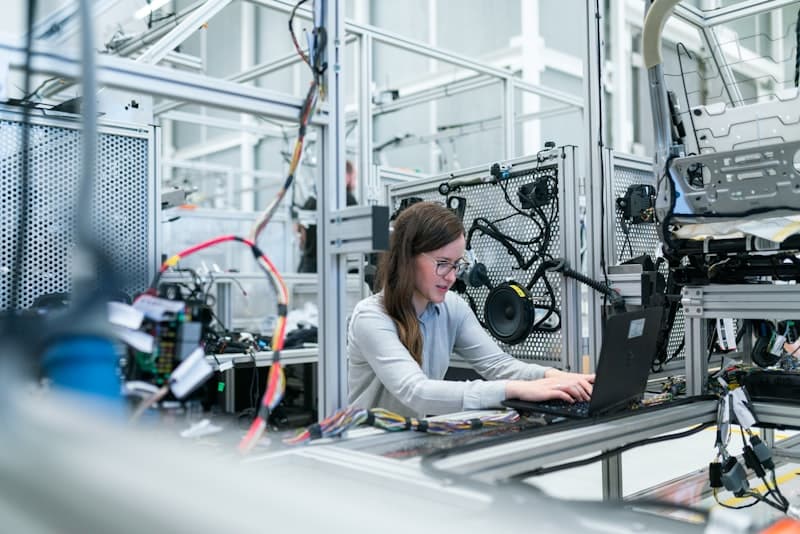
A smart factory is a next-generation facility that automates and intelligentizes the entire process — from product planning and design to production, distribution, and sales — using ICT technologies.
Having achieved the goal of deploying 30,000 smart factories by 2022, the government is now shifting policy toward advancing existing factories and driving AI- and data-driven manufacturing innovation.
KITIM provides systematic support for digital transformation of SME manufacturers, backed by on-site assessment committee experience and manufacturing innovation consulting expertise in smart factory deployment and advancement projects.


Smart Factory Maturity Levels
Smart factories are classified from basic to Level 4 based on ICT adoption, and each level requires a tailored strategy.
No ICT applied; manual production management
Basic ICT adoption (ERP, MES) for automated performance tracking
Automated equipment data collection, real-time monitoring and control
IoT and big data-driven analysis, prediction, and simulation optimization
AI-based autonomous operations, CPS (Cyber-Physical Systems) implementation
Consulting Services
We provide step-by-step smart factory consulting tailored to your company's current level and goals.
Smart Factory Implementation Consulting
We support the entire process from strategic planning for digital transformation of manufacturing sites and government subsidy applications to supplier selection. We minimize corporate burden by linking with the MSS and KOSMO smart factory deployment and expansion programs.
Smart Factory Advancement Support
We develop IoT, AI, and big data-based advancement strategies and support government program linkage to elevate existing smart factories. We provide customized roadmaps for progressing from Basic/Level 1 to Level 2/3.
Smart Factory Level Verification & On-Site Assessment
We strengthen smart manufacturing capabilities through pre-diagnosis and on-site consulting aligned with smart factory level verification criteria. Our consulting is grounded in hands-on experience as SBC certification on-site assessment committee members.
Production Innovation Consulting (G-Smart Factory)
We deliver productivity improvements, quality enhancements, and cost reductions through AI and data-driven manufacturing innovation consulting. We have experience as ICT specialists in the Gyeonggi SME Federation's G-Smart Factory Model development program.
Related Government Support Programs
We guide you through key government support programs available for smart factory implementation and advancement.
Smart Factory Deployment & Expansion
MSS / KOSMO (Smart Manufacturing Innovation Promotion)
50% government subsidy on implementation costs (up to KRW 100M)
Smart Factory Advancement Program
KOSMO (Smart Manufacturing Innovation Promotion)
50% support on advancement costs (up to KRW 150M)
Smart Manufacturing Innovation R&D
Ministry of Trade, Industry and Resources
Support for smart manufacturing technology development projects
Data-Driven Smart Factory
Ministry of SMEs and Startups
AI and big data-based manufacturing data analysis support
Consulting Guide by Level
We recommend consulting that matches your current smart factory level.
None → Basic
Estimated duration: 2–4 months
Funding: Up to KRW 100 million (government-funded)
- Smart factory adoption strategy
- Barcode/QR-based inventory management
- POP system implementation
- Basic data collection framework
- Government subsidy application consulting
Basic → Intermediate
Estimated duration: 3–6 months
Funding: Up to KRW 150 million (government-funded)
- MES (Manufacturing Execution System) adoption
- ERP integration and data consolidation
- IoT sensor-based monitoring
- Quality control automation
- Real-time production dashboard
Intermediate → Advanced
Estimated duration: 4–8 months
Funding: Up to KRW 300 million (government-funded)
- AI-based predictive maintenance
- Big data quality analytics
- Digital twin implementation
- Autonomous operation system design
- AI vision inspection adoption
Smart Factory Implementation Process
Certified Technical Consultants and Certified Management Consultants work together to build your smart factory systematically.
On-site Assessment
Shop-floor analysis and level evaluation
Strategy
Target level setting and roadmap
System Design
MES/ERP/IoT architecture design
Build & Trial Run
System build and on-site deployment
Training & Stabilization
Staff training and stabilization
Follow-up Support
Operational optimization and upgrade advisory
Build Your Smart Factory with Experts
On-site assessment by Certified Technical Consultants plus subsidy application consulting from Certified Management Consultants reduces your cost burden.
Cost & Duration
We provide customized quotes based on your smart factory level and company size.
| Consulting Service | Estimated Duration | Cost |
|---|---|---|
| Smart factory on-site assessment | 1–2 weeks | Upon consultation |
| Smart factory implementation strategy | 1–2 months | Upon consultation |
| Basic smart factory implementation | 2–4 months | Upon consultation |
| Smart factory advancement | 4–8 months | Upon consultation |
| MES/ERP adoption consulting | 2–4 months | Upon consultation |
| Government subsidy application consulting | 1–2 months | Upon consultation |
| AI & IoT technology adoption advisory | 2–4 months | Upon consultation |
* By leveraging government smart factory support programs, you can receive support for 50–70% of implementation costs.
Start Your Smart Factory Now
Boost manufacturing competitiveness with smart factory implementation using government subsidies.